SciSimulator
Free Interactive STEM Virtual Labs for Physics, Chemistry, Biology & Math
Learn core STEM concepts with interactive simulations, step-by-step guides, and quizzes — at your own pace.
Welcome back, Student · Ready to explore the universe today?
Physics
32 experiments
Chemistry
1 experiments
Biology
2 experiments
Mathematics
10 experiments
Finance
3 experiments
Featured Simulation

Ohm's Law Virtual Lab
Interactive circuit simulation demonstrating the relationship between Voltage, Current, and Resistance. Adjust components in real-time to verify V=IR.

Electrolysis of Water Simulation
Visualize the electrochemical decomposition of water into Hydrogen and Oxygen gas. Observe the 2:1 volume ratio, understand electrode reactions, and learn about Faraday's laws of electrolysis.

Pythagorean Theorem Visualizer
Interactive visual proof of the Pythagorean theorem (a² + b² = c²) using the rearrangement method. Drag and rotate squares to see how areas combine, perfect for understanding geometric proofs.

Photosynthesis Rate Lab
Investigate how Light intensity, CO₂ concentration, and Temperature affect the rate of photosynthesis. Observe oxygen bubble production and understand limiting factors in plant metabolism.
All Experiments
Ohm's Law Virtual Lab
Interactive circuit simulation demonstrating the relationship between Voltage, Current, and Resistance. Adjust components in real-time to verify V=IR.

Current in Series & Parallel Circuits Lab
Interactive physics simulation exploring current distribution in series and parallel circuits. Verify Kirchhoff's current law with virtual ammeters and observe how current splits at junctions.

Voltage in Series & Parallel Circuits Lab
Interactive physics simulation exploring voltage distribution in series and parallel circuits. Verify Kirchhoff's voltage law with virtual voltmeters and understand voltage division principles.

Volt-Ampere Method Resistance Calculator
Learn to measure unknown resistance using the Volt-Ampere method. Practice reading voltmeter and ammeter scales, calculate resistance using Ohm's law, and understand measurement errors.

Measuring Electric Power Simulation
Measure electric power of a small light bulb using the Volt-Ampere method. Observe how power changes with voltage, understand P=VI relationship, and compare rated vs actual power.

Geometric Optics Virtual Lab
Explore light refraction and image formation with convex lenses. Understand the thin lens equation, observe real and virtual images, and discover the relationship between object and image distance.

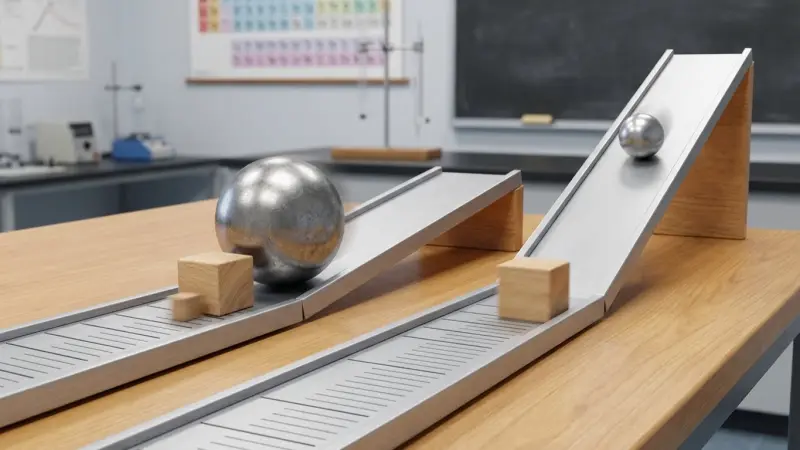
Kinetic Energy: Mass & Velocity Factors
Explore the kinetic energy formula (Ek = ½mv²) through interactive collision experiments. Investigate how mass and velocity affect kinetic energy and discover the quadratic relationship between velocity and energy.
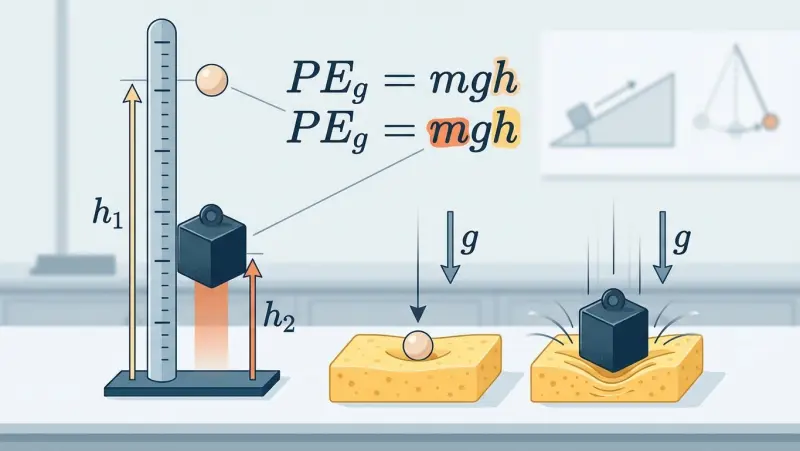
Gravitational Potential Energy: Mass & Height
Explore the gravitational potential energy formula (Ep = mgh) through interactive drop experiments. Investigate how mass and height affect potential energy and observe the energy transfer through sponge compression.
Electrolysis of Water Simulation
Visualize the electrochemical decomposition of water into Hydrogen and Oxygen gas. Observe the 2:1 volume ratio, understand electrode reactions, and learn about Faraday's laws of electrolysis.
Pythagorean Theorem Visualizer
Interactive visual proof of the Pythagorean theorem (a² + b² = c²) using the rearrangement method. Drag and rotate squares to see how areas combine, perfect for understanding geometric proofs.

Galton Board Simulator
Simulate the Central Limit Theorem and Normal Distribution using a Galton board. Watch balls bounce through pegs to form a bell curve, and understand how random events create predictable patterns.

Monte Carlo Simulation & Pi Estimator
Estimate Pi using Monte Carlo random sampling. Drop points randomly in a square containing a quarter circle, calculate the ratio, and watch the estimate converge to π as sample size increases.

Riemann Integral Visualizer
Explore the definition of the definite integral using left, right, and midpoint Riemann sums. Visualize how increasing rectangles approach the exact area under a curve.

Koch Snowflake Generator
Explore the construction of the Koch snowflake fractal and its paradoxical properties—infinite perimeter enclosing finite area. Adjust iteration levels to see the fractal pattern emerge.

Compound Interest: The Magic of Time
Compare an 'Early Bird' and a 'Diligent Saver' to witness the amazing power of compound interest—starting early beats saving more.

Compound Interest: Regular Savings
Visualize how compound interest accumulates over time to create wealth. Compare different interest rates and contribution amounts to understand the exponential growth of regular savings.

Menger Sponge Generator
Explore the Menger Sponge, a fascinating 3D fractal with infinite surface area and zero volume. Rotate the interactive model and increase iteration levels to discover its self-similar structure.

Lever Balance Virtual Experiment
Explore the principle of moments (torque) and verify the lever equilibrium condition F1×L1 = F2×L2. Add weights at different positions to understand mechanical advantage and balance points.
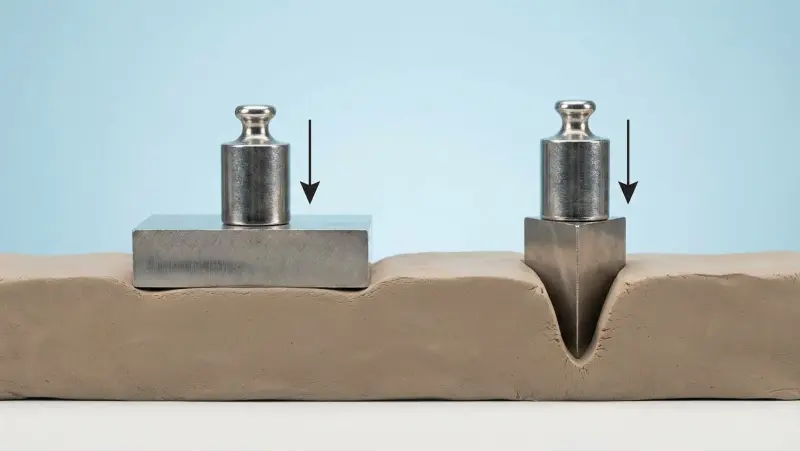
Factors Affecting Pressure
Interactive simulation exploring the relationship between Force, Area, and Pressure (P=F/A). Observe how pressure changes when you adjust force or contact area using real-world examples.

Pinhole Imaging Simulator
Explore how light travels in straight lines to form an inverted image through a pinhole camera. Adjust pinhole size and distance to observe changes in image brightness and sharpness.

Law of Reflection Virtual Demo
Interactive demonstration of the law of reflection. Adjust the angle of incidence and observe how the angle of reflection equals it. Verify that incident ray, reflected ray, and normal lie in the same plane.
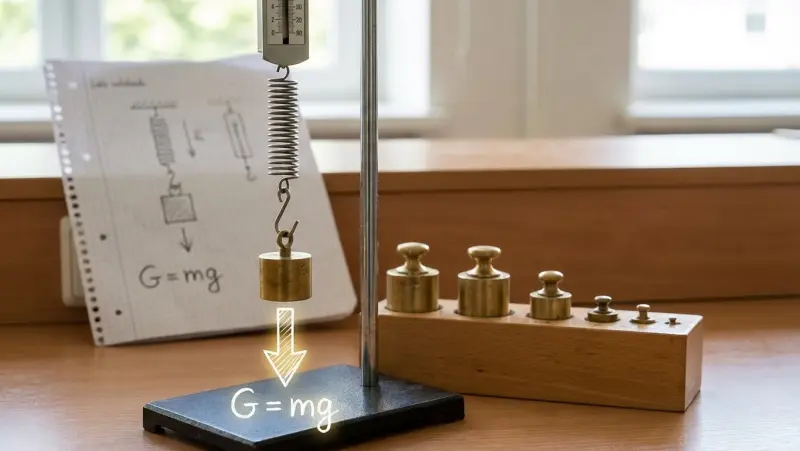
Gravity vs Mass Lab
Quantitative exploration of the proportional relationship between weight and mass (G=mg). Use a spring scale to measure objects of different masses and calculate the gravitational field strength.
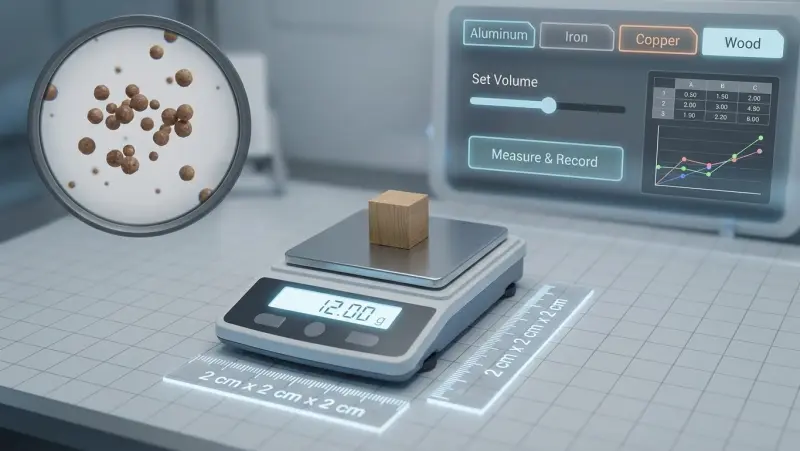
Density: Mass vs Volume
Investigate why objects of the same volume have different masses. Measure mass and volume of various materials to calculate density and understand this fundamental property of matter.
Photosynthesis Rate Lab
Investigate how Light intensity, CO₂ concentration, and Temperature affect the rate of photosynthesis. Observe oxygen bubble production and understand limiting factors in plant metabolism.

Light Dispersion Prism Simulator
Explore the dispersion of white light into a visible spectrum using a prism. Understand how different wavelengths refract at different angles, creating the rainbow of colors (ROYGBIV).

Plane Mirror Imaging Simulator
Explore the characteristics of images formed by plane mirrors: same size as object, same distance from mirror, laterally inverted, and virtual. Verify these properties through interactive ray tracing.

Vision Correction Simulator
Explore how myopia (nearsightedness) and hyperopia (farsightedness) are formed and corrected using concave and convex lenses. Understand the optics of the human eye and corrective eyewear.

Liquid Pressure Virtual Lab
Explore how liquid pressure relates to depth and density using a U-tube manometer. Verify P=ρgh and understand why pressure increases with depth and varies between different liquids.

Archimedes
Explore Archimedes' principle: buoyant force equals the weight of displaced fluid. Investigate how buoyancy depends on liquid density and submerged volume, not object weight or shape.

Photoelectric Effect
Explore Einstein's photoelectric effect equation (E=hf-W) and the particle nature of light. Observe how changing light frequency and intensity affects electron emission from metal surfaces.

Factors Affecting Resistance
Explore how material, length, cross-sectional area, and temperature affect the resistance of a conductor. Verify R=ρL/A using the control variables method.

Melting Characteristics
Compare the melting process of crystalline (sodium thiosulfate) and amorphous (paraffin wax) solids. Plot temperature-time graphs to observe the constant melting point of crystalline substances.

Mendelian Monohybrid Cross
Explore Mendel's Law of Segregation through monohybrid crosses. Simulate genetic inheritance, observe the 3:1 phenotype ratio in F2 generation, and understand dominant and recessive alleles.
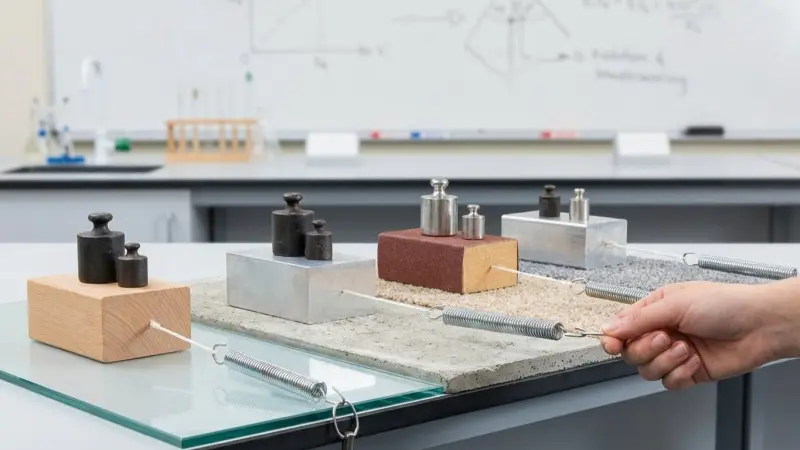
Factors of Sliding Friction
Explore the relationship between sliding friction, normal force, and surface roughness. Verify f=μN and understand why friction is independent of contact area.
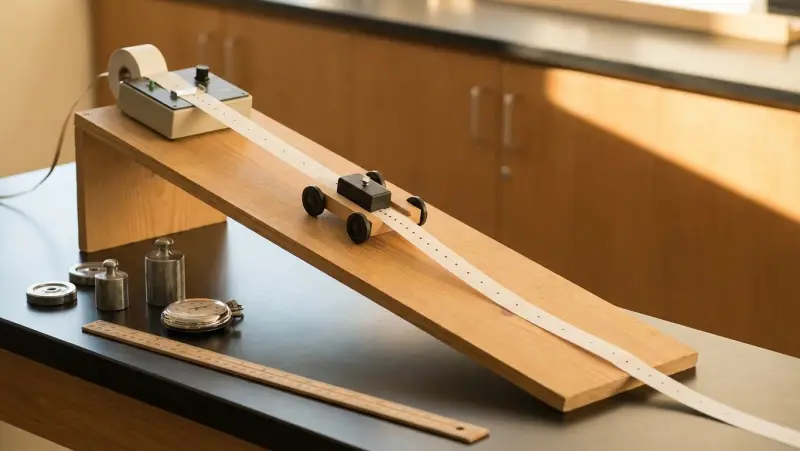
Cart Acceleration Simulation: Speed-Time Analysis
Interactive physics simulation: Analyze cart motion on an inclined plane using a ticker timer. Calculate acceleration with the successive difference method and compare with theoretical values.
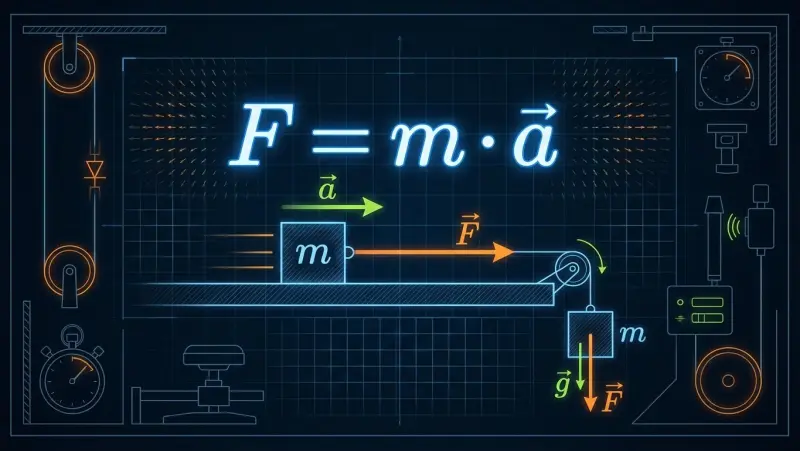
Newton's Second Law
Interactive simulation exploring Newton's Second Law (F=ma). Use control variables method to investigate how acceleration depends on net force and mass. Analyze data to verify the linear relationship.
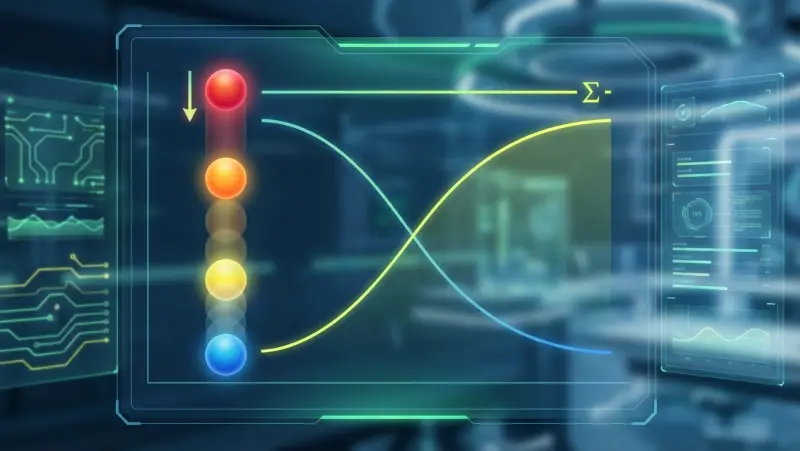
Mechanical Energy Conservation: Free Fall
Verify the conservation of mechanical energy (mgh=½mv²) using a ticker timer. Calculate instantaneous velocity, compare potential and kinetic energy, and analyze errors.
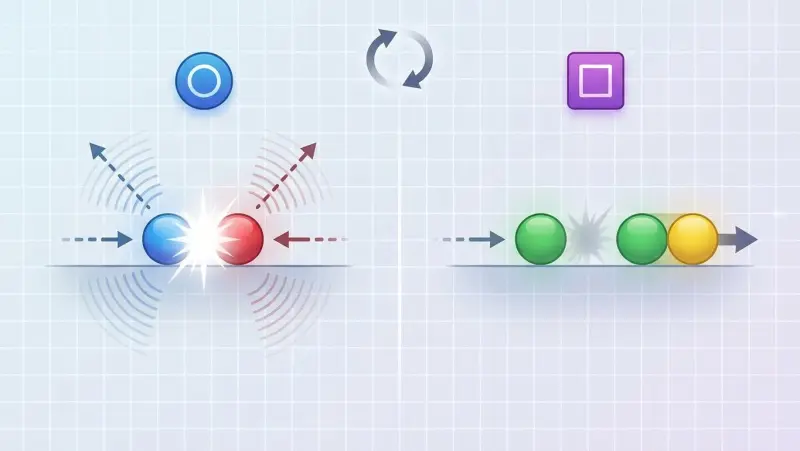
Momentum Conservation: Collisions Lab
Free online physics simulation: Explore momentum conservation through ball collisions. Adjust mass, velocity & elasticity to verify p=mv. Perfect for high school physics students.
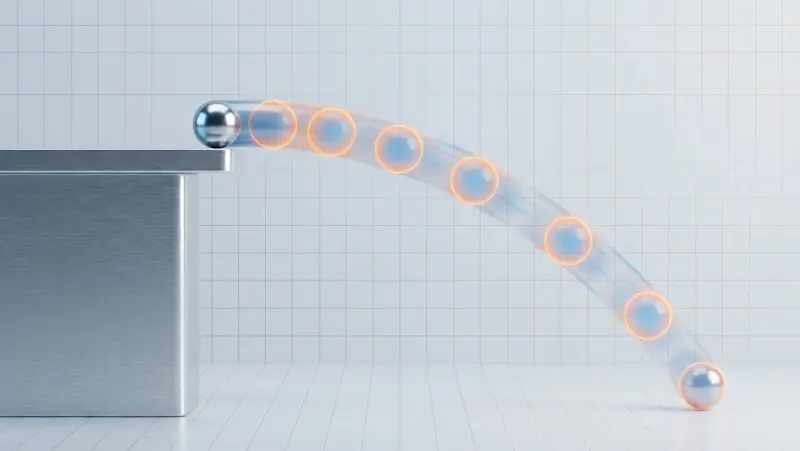
Horizontal Projectile: Motion Independence
Free Physics Simulation: Compare trajectories of red, blue, and green balls using strobe photography. Verify the independence of motion and analyze horizontal uniform motion vs. vertical free fall.
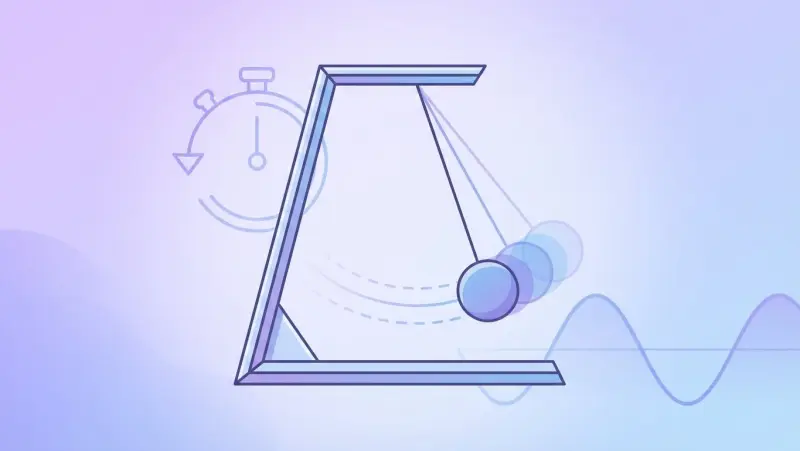
Simple Pendulum Period Lab
Free physics simulation: Explore the relationship between pendulum period and length using control variables. Verify the period formula T=2π√(L/g) and discover that period depends only on length, not mass or amplitude.
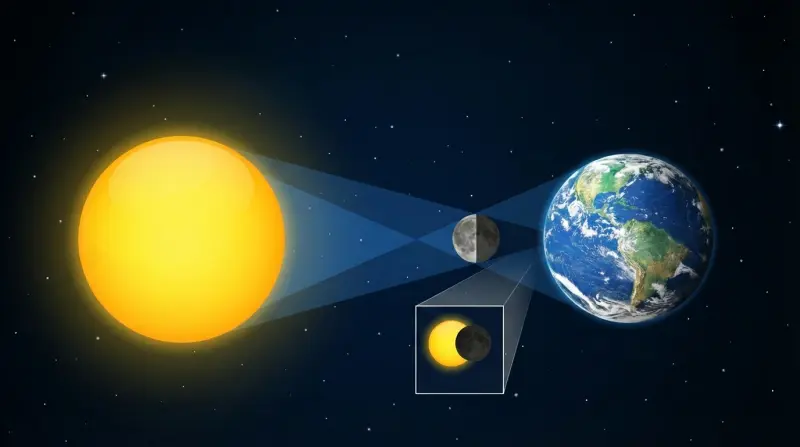
Solar Eclipse Simulation: How Eclipses Form
Interactive astronomy simulation exploring how the alignment of the Sun, Moon, and Earth creates solar eclipses. Adjust lunar orbital position and inclination to observe the conditions for total, partial, and annular eclipses, and understand how orbital tilt affects eclipse frequency.
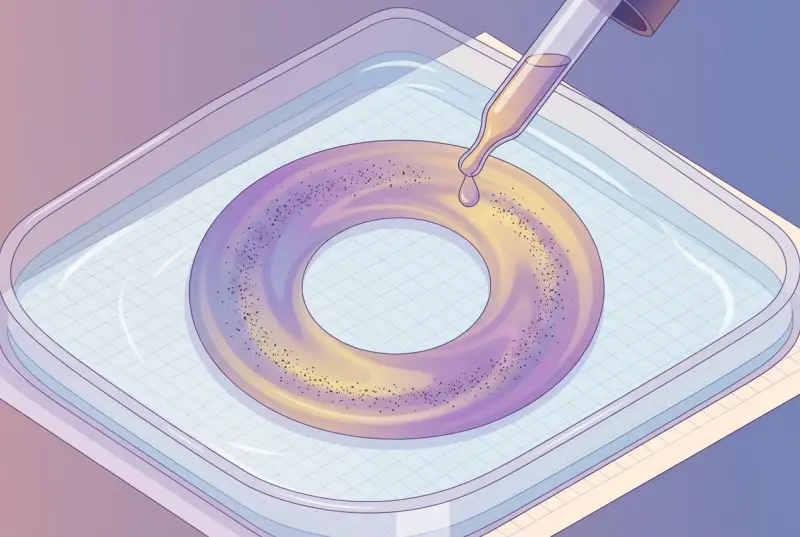
Estimating Molecular Size: Oil Film Method
Drop an oleic acid–alcohol solution onto a water surface to form a monomolecular oil film. Measure the film area and calculate the volume of pure oleic acid to estimate the molecular diameter using d=V/S—revealing the order of magnitude of ~10⁻¹⁰ m.
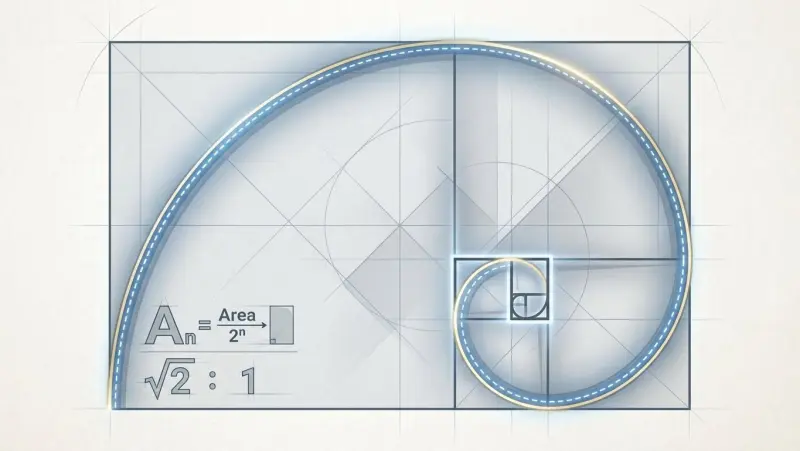
A4 Paper: The Ratio Secret
Interactive simulation exploring A-series paper's aspect ratio. Learn why A3 folds into A4, discover self-similarity, and understand irrational numbers in real life.
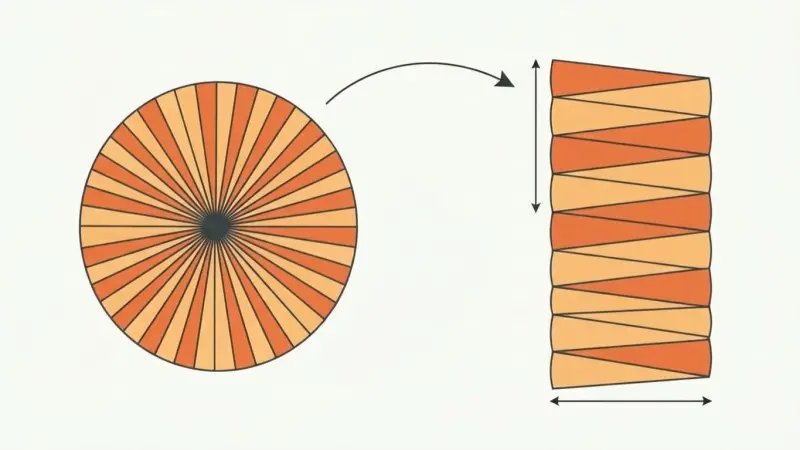
Circle Area Formula Derivation
Interactive math simulation: Visualize the derivation of Area = πr² by transforming a circle into a rectangle. Understand the limit concept intuitively.
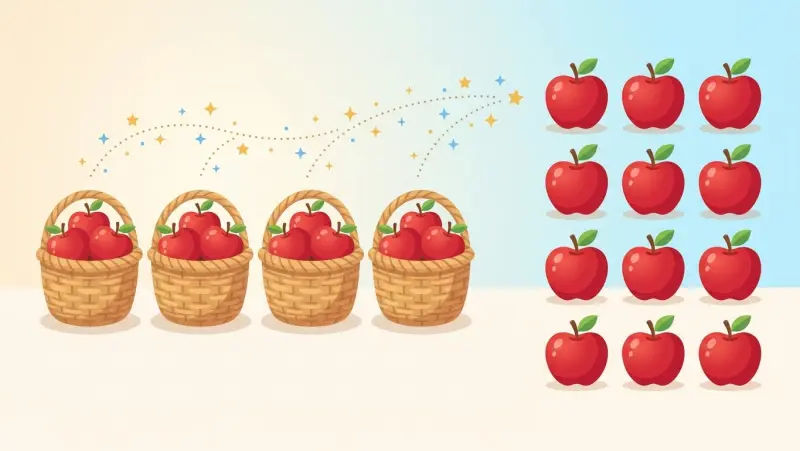
Multiplication Enlightenment: The Magic Orchard
Interactive Math for Elementary: Visualize repeated addition vs multiplication and commutative property via basket counting and array arranging.
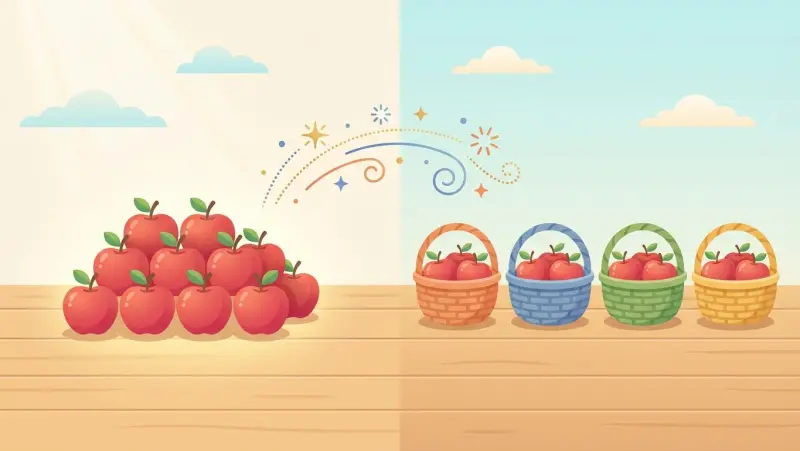
Division Visualized: Fair Share & Packing
Free interactive math experiment: Understand the two meanings of division through an apple-sharing game—Fair Share (given groups, find per group) and Packing (given per group, find groups). Visualize dividend ÷ divisor = quotient...remainder. Grades 2-4.

QE & QT Simulation: Central Bank Balance Sheet Expansion and Contraction
Free interactive finance lab: simulate the full QE and QT process. Watch the flow of money between Treasury, primary dealers, and the central bank to grasp the assets=liabilities first principle and the real-world transmission to rates, valuations, and inflation.